The things your cat does can tell you a lot about what motivates them, what they enjoy doing, and most importantly, what they need on a daily basis. I emphasize that last point because it’s almost always what’s hiding behind a behavior: the motivation to fulfill a need!
I’m bringing this up because this is where you can make the biggest difference. If some of your cat’s behaviors bother you, the solution is often found here: can I meet that need in a different way? Or perhaps: am I responding to that need incorrectly, and is there something I need to change?
So, let’s take a closer look at five feline behaviors that cat parents commonly observe in their daily lives... but sometimes misunderstand!
Behavior #1: The Cat That Doesn't Properly Cover Their Waste
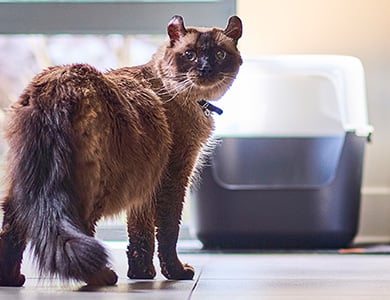
The most common interpretation of this behavior is often: “My cat isn’t smart enough to understand how to cover their waste.”
Let’s clear something up right away: our cats are much smarter than we often give them credit for. Your cat absolutely knows how and why to cover their waste. In fact, I’d even say they don’t need to think about it. It comes naturally to them.
So why are they scratching somewhere other than the litter itself? There can be several explanations, but here are the two most common ones:
- They scratch the sides or outside of the litter box because they don't have enough space. If your cat isn't doing a great job of covering their waste, the size of the litter box could be part of the problem. They need enough room to turn around and change positions comfortably, which helps them dig and cover properly. If they feel cramped, they may rush to get out instead of finishing the job.
- They scratch the sides or outside of the litter box because it's too dirty and they don't want to step in it. The less frequently the litter is cleaned, the more it starts to resemble a minefield. And I can assure you, your cat doesn't want to step on a mine! The cleaner the litter box, the easier it is for them to move around and find clean litter to dig in and cover their waste.
Behavior #2: The Cat That Bites Your Hands
Biting is complex because it can happen in different situations, for different reasons, and with different levels of intensity. So I'd like to focus here on the light bites your cat gives seemingly “for no reason.”
You may think they're playing incorrectly, but hunting and attacking behaviors are actually a normal part of feline play! Your cat is simply responding to their need for intense play and to "attack" their prey, which in this case happens to be your hand or forearm.
To help redirect this behavior, make sure you always have appropriately sized toys nearby so your cat has something to scratch, kick, and bite instead. Over time, they'll learn to target the toys rather than your limbs.
P.S. Your cat may also bite because you've been petting them for too long or touching a sensitive area. A gentle bite is simply their way of saying, “Stop!”
To prevent this from happening, watch for the warning signs: the tail starts flicking more sharply, the ears turn to the sides, the body becomes less relaxed, and so on.
Behavior #3: The Cat That Gets Bored of Playing

Do you start playing with your cat only to have them lose interest after two minutes? The reason is probably not what you think.
They're not lazy or uninterested. They simply need a game that's genuinely stimulating! And the most common mistake, one we've almost all made at some point? Playing the wrong way!
We're often too rushed and make things too easy for our cats. For example, placing the toy directly in front of their face. That's not stimulating at all.
So what's the solution?
First, make sure you build anticipation and get your cat interested before the game starts. Then follow a natural bell-shaped sequence: gentle, intense, very intense, intense, gentle, game over.
By making the beginning a little more challenging, you'll automatically activate your cat's hunting instinct. Once you have their attention, you can increase the intensity, but don't let them "win" every single time. In short, the game should imitate a hunting session and remain a challenge!
Behavior #4: The Cat That Brings You Their Prey

It's not a gift. It's not their share of the rent. And it's not even a hunting lesson.
When your cat brings you prey, it's simply a sign that they feel comfortable in their environment and with you.
In the wild, small felines don't necessarily consume their prey exactly where they catch it. Doing so could leave them exposed and vulnerable. Instead, they often bring it somewhere safer before settling down.
So whether it's a real prey item or simply a toy left in an odd place around the house, it's really nothing more than a sign that your cat feels secure.
Pretty special, isn't it?
Behavior #5: The Cat That Hisses

I'm bending the rules a little with this one because hissing is first and foremost a reaction.
Many people mistakenly believe that a cat who hisses, growls, or attacks is being deliberately mean or aggressive. In reality, these behaviors are usually responses to a stressful or uncomfortable situation.
Do you see the difference?
Understanding why a cat is hissing is essential if you want to respond appropriately. Once you recognize that the behavior is rooted in discomfort rather than malice, you're much more likely to consider the context and find ways to reduce your cat's stress.
The next time your cat hisses, try shifting from frustration to curiosity:
"Okay, my cat is hissing. What's making them uncomfortable right now? How can I help end this situation so they can feel calm again?"
This is definitely not the time to punish your cat. Quite the opposite. Your calm and gentle approach will help them regain a sense of comfort much more quickly.
I wanted to end with the hissing cat because it's probably one of the most misunderstood feline behaviors.
My hope is that we can learn to appreciate these cats just as much and offer them the same compassion we naturally extend to calmer, less reactive cats.
More broadly, I hope we all make time for our cats. Time to observe them and think about the needs hidden behind their behaviors. When we take a moment to do that, it can completely transform the relationship we share with them.