Social media has the power to revive ideas we thought had disappeared. And cats, with their unique and sometimes enigmatic personalities, are often at the heart of these persistent beliefs. Some of these misconceptions are amusing, others more troubling. But they all share one thing in common: they deserve to be debunked.
On this International Cat Day, August 8, 2025, let’s take a moment to leave some of these myths behind. Understanding them better also means living better with them. Because cats are far more fascinating than any collection of clichés.
My name is Daniel Filion, also known as L’Éduchateur. For over twenty years, my team and I have been helping people turn problematic feline behaviors into concrete and lasting solutions. Too many myths still circulate, and too much questionable advice spreads online. Meanwhile, cats continue to suffer, misunderstood. My role is to clear the air, one myth at a time.
1. A cat’s coat color influences its personality
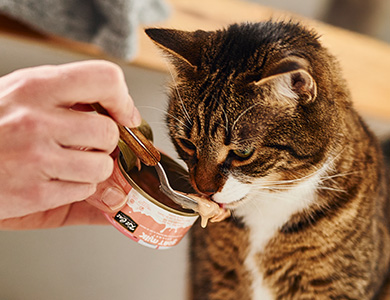
Studies in the United States and the United Kingdom have shown that our judgments are heavily influenced by media. Characters like Garfield, The Aristocats, and Felix the Cat have all contributed to creating stereotypes that link coat color with personality traits.
- Orange cats are said to be greedy and friendly.
- Black and white cats, sociable.
- White cats, fragile or snobbish.
- And calicos? Simply temperamental.
In truth, no serious scientific study has ever found a connection between coat color and personality. What really shapes a cat’s behavior is its genetics (beyond color), environment, socialization, and life experiences. Even breed has surprisingly little influence on feline behavior.
2. Cats can smother a baby by lying on them
This myth dates back to the 1970s and 1980s, a time when Sudden Infant Death Syndrome (SIDS) was still poorly understood. Occasionally, the family cat was found lying near the baby and was blamed, simply by association.
A cat might be drawn to a crib for several reasons. It’s warm, central in the home, comfortable, and filled with new and intriguing scents. But the idea that a cat would try to “steal the baby's breath” or intentionally smother them is pure fiction.
If you’ve ever seen a mother cat squeeze into a tiny box with her kittens without crushing a single one, you’ll understand that an adult cat is not a threat to a human baby. Honestly, a lightning strike hitting the crib indoors is more likely than a cat smothering a child.
3. Cats can sense when someone is afraid or allergic

Cats aren’t emotion detectors or allergen sensors. They don’t deliberately seek out the one person in the room who’s afraid or allergic. What’s really going on is the opposite. Cat lovers tend to look at, speak to, and approach cats. People who are afraid or allergic often ignore them completely. Cats read this neutral body language as non-threatening, especially when everyone else is actively trying to engage with them. So they often gravitate toward the quietest person in the room, not by intent, but by instinct.
4. Cats love milk
That classic movie scene, the cat eagerly lapping from a bowl of milk, has stuck in our minds. And yes, some cats may love the taste. However, most adult cats lack the enzyme needed to digest lactose, making them intolerant, just like many humans. This can lead to diarrhea, gas, and discomfort. Milk isn’t toxic, but it’s far from being an ideal treat. And no, your cat doesn’t automatically know what’s good for them. Giving milk regularly means feeding into a false image, not a real need. If your cat enjoys it, consider lactose-free milk made specifically for cats.
5. Cats can see ghosts
A cat stares at a wall, tracks something invisible with its eyes, or jumps at seemingly nothing. What do many people assume? Of course, the classic “sixth sense” that detects spirits or ghosts.
In reality, cats hear sounds at much higher frequencies than we can, up to four times higher. They might hear a mouse moving inside the wall, the vibrations of a musical instrument from a nearby apartment, or even the ultrasonic calls of a bat bouncing off the walls from an open window. It’s not the paranormal, it’s biology.
6. Slow blinking calms cats
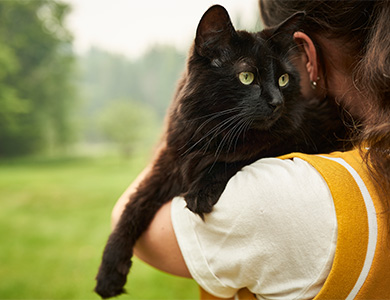
In the late 2000s, a book described a set of behaviors seen in mammals known as “calming signals.” The original goal was to highlight non-confrontational behaviors used to avoid conflict. But by labeling them as calming signals, a major misinterpretation followed.
The idea was embraced by both professionals and the general public. Many mistakenly concluded these signals could calm others, or even oneself. Soon, people began suggesting that humans could use slow blinking to calm a stressed animal.
Among these behaviors, the slow blink became widely popular. Many professionals, including veterinarians and behaviorists, began saying that when a cat returned a slow blink, it was a sign of comfort. This led to frequent advice to blink slowly at cats to soothe them, especially during vet visits or stressful handling.
It took nearly a decade for science to seriously address this idea. A simple renaming of these signals was enough to flip their interpretation. They aren’t calming signals, they’re signs of discomfort or avoidance. So if a cat blinks slowly after you do, it’s not comfort, it’s caution. They may perceive your blink as strange or ambiguous, which can actually increase their unease.
Had these signals been labeled as signs of discomfort from the start, we might have avoided this widespread misinterpretation. This case shows how naming things properly truly matters. In this instance, the consequences are minor. But in other contexts, like the widely misunderstood idea of “dominance,” poor terminology can lead to harmful, ineffective, or even dangerous practices. Because no, dominance, in the popular sense, does not exist in cats.
Persistent myths worth debunking
The social media myth
Cats pee outside the litter box out of revenge or jealousy. False. These behaviors are always linked to specific litter box issues, such as location, cleanliness, type, or quantity.
The old-timey myth
Black cats absorb evil spirits in the home. If one crossed your path, you were said to inherit one of those spirits. This belief still affects the reputation of black cats today.
The mystical myth
If a cat lies on the bed of a sick person, it means death is near. In reality, cats notice changes in a person’s breathing or posture and often lie nearby out of curiosity or concern.
The bizarre but persistent myth
If a young woman steps on a cat’s tail, she’ll remain single for life, unless she prays to Saint Philomena for 28 nights.
The one that’s absurd but still told
An American version of the smothering myth claims a cat will stick its tail in a baby’s mouth. It’s pure nonsense, yet still gets repeated.
The discriminatory myth
Black cats bring bad luck. This is one of the oldest myths, and it still has consequences. Even today, black cats are adopted far less frequently than cats of other colors.
Let’s rethink the cat, one myth at a time
Many of these myths persist because they’re simple, appealing, or deeply ingrained. But by debunking them, we open the door to a better understanding of cats and a more respectful relationship. On this International Cat Day, let’s celebrate our feline companions for who they truly are. Not as mystical or unpredictable creatures, but as sensitive, intelligent, and deeply lovable beings.
Everything you need to celebrate International Cat Day: